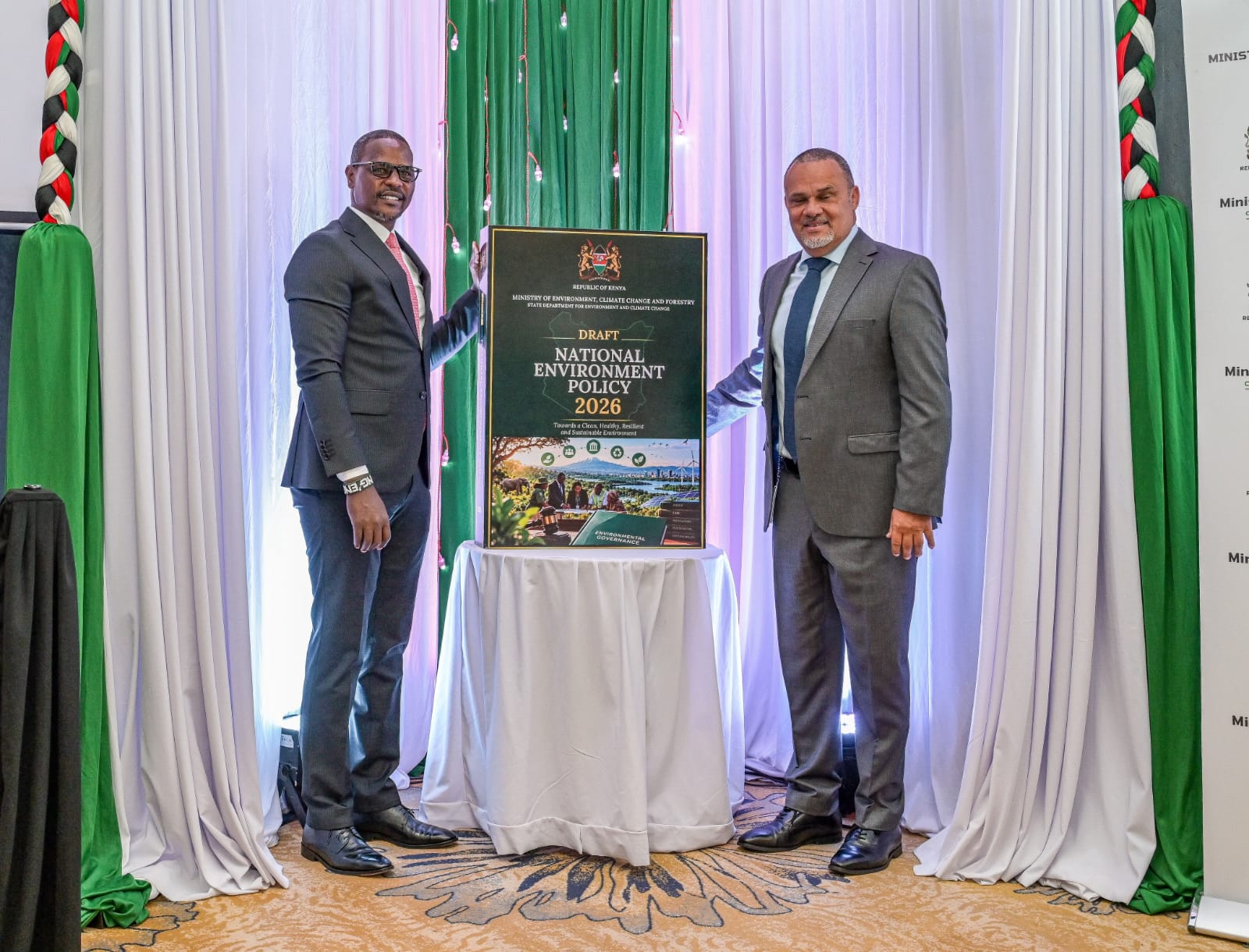
The government has launched the Draft National Environment Policy 2026, opening the document for stakeholder review and public participation as Kenya seeks to strengthen environmental governance and address emerging ecological challenges.
Principal Secretary for Environment and Climate Change Dr. Eng. Festus Ng’eno unveiled the draft during a breakfast meeting in Nairobi attended by representatives from county governments, development partners, civil society, academia, the private sector and environmental experts.
Dr. Ng’eno said the government reviewed the 2013 policy to align it with changing environmental realities, constitutional requirements and international commitments.
He noted that Kenya adopted the current policy before the Paris Agreement, the Climate Change Act, carbon market regulations and the Sustainable Waste Management Act, 2022 came into force.
“Today, I have the honour to place before the People of Kenya the First Draft of the National Environment Policy, 2026,” he said.
The proposed policy draws its foundation from Articles 10, 42, 69 and 70 of the Constitution. It seeks to strengthen environmental rights, accountability, public participation and sustainable management of natural resources.
The draft also aims to improve coordination between the national and county governments. It proposes a single intergovernmental mechanism to guide devolved environmental functions and streamline decision-making.
At the same time, the policy addresses emerging issues such as climate change, biodiversity loss, pollution, land degradation and the growing role of artificial intelligence in environmental management.
It also responds to climate-related challenges, including rising water levels in Rift Valley lakes, which continue to threaten infrastructure, ecosystems and livelihoods.
Kenya has aligned the proposed policy with its international obligations on climate action and biodiversity conservation. The framework supports the country’s target of reducing greenhouse gas emissions by 35 percent by 2035 while protecting 30 percent of its land area.
Dr. Ng’eno said environmental sustainability must remain central to Kenya’s development agenda beyond Vision 2030. He pointed to renewable energy, green jobs, resource efficiency and climate resilience as key drivers of future growth.
He also called for broad public participation in the review process. Women, youth, persons with disabilities, pastoralists, indigenous communities and local groups must have a voice in shaping the final document, he said.
The Principal Secretary said the government aims to complete the review by December 12, 2026, after consultations, validation and final stakeholder engagement.
He commended UNDP Kenya, CEJAD, WWF, the Council of Governors, Technical Working Groups and a team led by Prof. Robert Kibugi for supporting the review process.
Once adopted, the National Environment Policy 2026 will guide Kenya’s efforts to protect the environment, manage natural resources sustainably and accelerate the transition to a green, climate-resilient economy.
The launch marks the start of a nationwide consultation process that will allow Kenyans to help shape the country’s environmental agenda for the next decade.