Equity Group Holdings deployed more than KSh26 billion in sustainable and climate-aligned finance in 2025, and planted 9.1 million trees. That takes its cumulative total to 44.6 million, well above its 35 million target, according to the Group’s 2025 Sustainability Report.
The climate spending sits within a record KSh99.5 billion (US$771 million) the Group says it invested in social impact and sustainability across its markets. That figure also covers enterprise development, education, healthcare and financial inclusion.
Climate and agriculture
Equity says it recorded more than 47,000 climate-related transactions under the IFC Climate Adaptation Finance Initiative. It also distributed 75,855 clean energy products during the year.
In agriculture, the Group says it reached 622,525 small and medium-sized farmers through climate-smart financing, capacity building and value chain integration. It says this improved food security, raised on-farm productivity and reduced production risk across the region’s main farming areas.
The report also tracks the Group’s greenhouse gas emissions, energy use and water consumption. The Group has published its first Sustainable Development Impact Disclosure Report as well, which the sustainability report describes as Africa’s second.
Equity says it is building environmental, social, climate and nature-related factors into credit decisions, operations and risk management. Its tools include environmental and social risk screening, enhanced due diligence for high-risk sectors, climate scenario analysis and stress testing.
The Group is also preparing to apply the IFRS S1 and S2 sustainability disclosure standards. The report acknowledges that disclosure controls and the quality and consistency of non-financial reporting remain areas for improvement.
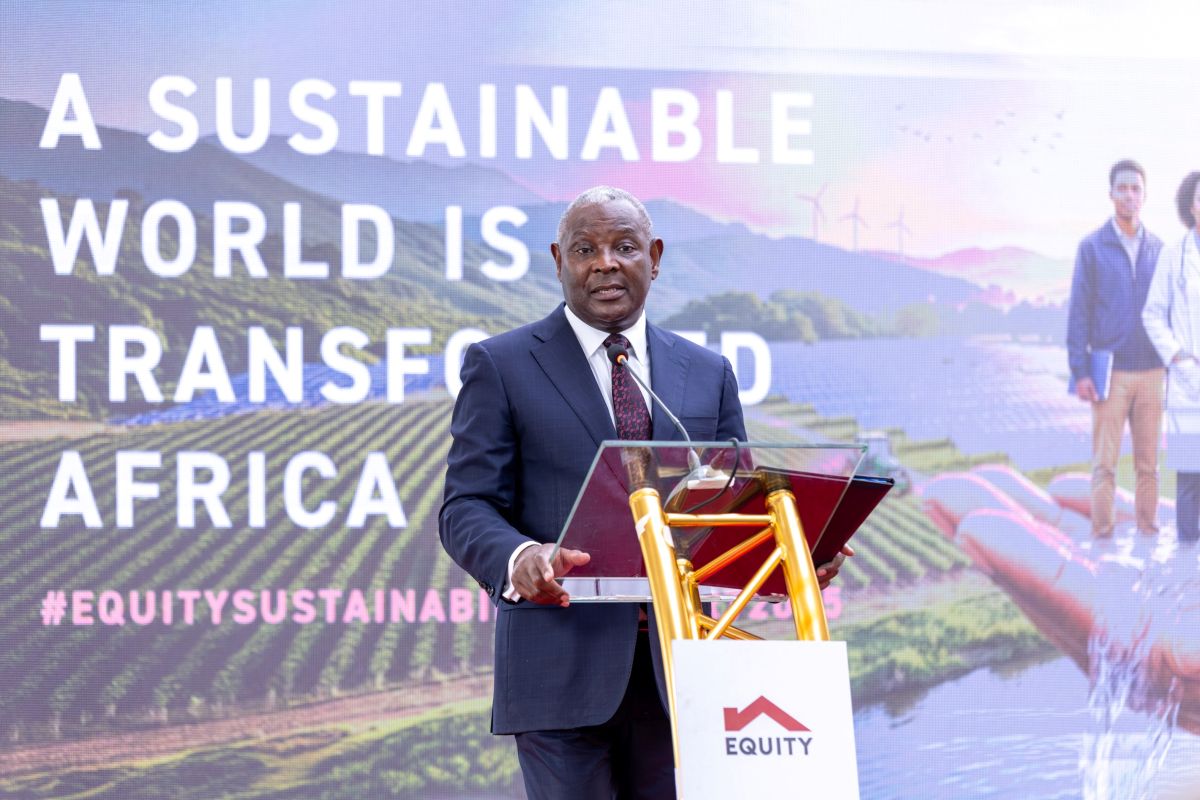
The report, themed “A Sustainable World is a Transformed Africa,” is organised around the Group’s Tri-Engine Model, which combines economic performance, social impact and sustainability.
“Mutually reinforcing”
Group Managing Director and CEO Dr James Mwangi said commercial success and sustainable development are not competing priorities but “mutually reinforcing drivers of long-term prosperity.” The stronger the business, he said, the greater its capacity to invest in people, enterprises and communities.
He added that the Group’s responsibility is to turn potential into productive opportunity “while protecting the natural systems that make prosperity possible.” That means directing finance towards resilience and ensuring people and nature are not treated as afterthoughts in development, he said.
German Ambassador to Kenya Sebastian Groth said achieving sustainable development at scale needs strong partnerships between governments, the private sector and development institutions. He said the era of traditional aid is giving way to investing in a shared future on equal terms, with public funds used to mobilise private capital. Equity’s focus on renewable energy, local value addition and catalytic climate finance, he said, shows that sustainability can drive transformation for the many.
Nasra Nanda, Built Environment Lead at the Executive Office of the President, said financial institutions have a decisive role in making resilient, sustainable construction accessible to ordinary borrowers. They can do this by financing the enterprises and skills behind the transition and building nature and resilience into investment decisions from the outset, she said.