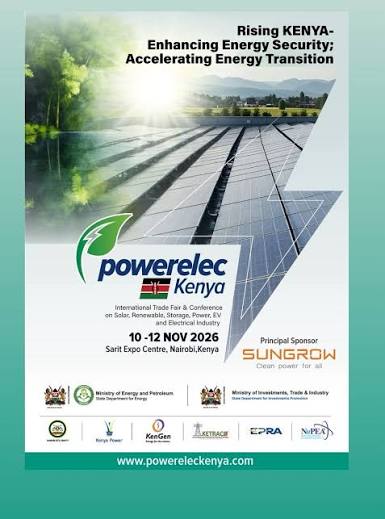
Kenya’s ambition to strengthen its position as a regional clean energy hub will be in focus at Powerelec Kenya 2026, an international exhibition and conference bringing together energy companies, investors, technology providers and policymakers from more than 40 countries.
The event, scheduled for 10–12 November at Nairobi’s Sarit Expo Centre, comes as the country seeks to expand its renewable energy capacity, strengthen electricity infrastructure and accelerate the adoption of energy storage and electric mobility.
Kenya currently generates more than 90 per cent of its electricity from renewable sources, according to the event organisers. However, integrating more renewable energy into the system will require investment in storage, grid infrastructure, digital technologies and new financing models.
These challenges form the centrepiece of the three-day conference, whose theme is Kenya is on its journey to become Africa’s Energy Capital by upscaling transition in Renewables, AI, Nuclear and E-Mobility.
Discussions will examine the economics of battery storage for commercial, industrial and rural applications, alongside the role of digitalisation, smart meters and artificial intelligence in improving energy efficiency and reducing emissions.
Industry leaders will also discuss green finance, including access to climate funds, green bonds and financing structures for renewable energy projects. A dedicated CEO Forum will explore women’s leadership, access to investment and opportunities for women-led energy enterprises.
The final day will focus on Kenya’s major energy infrastructure projects, including geothermal, wind, solar and hydropower, before examining electric mobility, charging infrastructure and financing models for electric vehicle adoption.
Among the speakers are Kenya Power CEO Dr Joseph Siror, representatives from Siemens Energy, JA Solar, Jinko ESS, PowerGen Renewable Energy, NCBA Bank, BasiGo, the Geothermal Development Company and the Energy and Petroleum Regulatory Authority.
For sustainability professionals, the exhibition offers an opportunity to engage directly with technology providers, assess emerging solutions, explore financing and partnerships, and understand the commercial and infrastructure developments shaping the region’s energy transition. Businesses can also connect with international manufacturers and investors seeking opportunities in African markets.
The exhibition will feature national pavilions from India, Korea, Turkey and Egypt, with more than 400 investors expected.